Monday, January 19, 2015

The Truth

[If you're only interested in the truth about the Norwegian economy, feel free to scroll down!]


I may be far from the smartest or the most experienced voice among the Norwegian economic and financial commentators. But I have one advantage compared to practically all of the commentators you see on mainstream media (Dagens Næringsliv, NRK, Aftenposten, etc): I have no superior who's opinion and interests I would try to take into account when I talk about the economy. The lack of this kind of a boss does not give me any pure, 100 % independence, but I cannot think of any person who scores better than me on this one (many bloggers might tie with me, though). My only "bosses" are my readers, and I try to write what I know you want to read but without asking you for your approval or even comments beforehand. Sometimes I manage better, but sometimes my self-critical "bullshit radar" lets me down.

I said I know what you want to read. What is it then? It is nearly always the truth. I have learned recently that what makes even a stand-up comedian succeed is being able to tell the truth, from a new angle. For us who write, or act, the challenge is to try to deliver the truth without letting our conflicting interests get in the way. A writer like me knows that my audience wants the truth, but I --like everyone else-- only have my truth. I have many interests that may conflict with the truth, interests I need to remain aware of (e.g, the wish to be right rather than wrong), but my employer's interest is not one of them. I do not even have any career interest, other than that I have found speaking one's mind usually rather career enhancing as long as one does it even somewhat politely. To speak the truth: While sharing my truth, I have too often been impolite --many times unknowingly, although others might have viewed it differently-- and it nevertheless has not got me fired and has rather brought me acceptance among the higher ranks of the leadership. I got this kind of praise even when I was, paradoxically, fully prepared to make them pissed at me. (Actually I once made one "big boss" outright angry, only to later earn respect from him for my conduct that day.) They don't usually give you praise publicly, because the last thing they want is everyone trying to follow your example. There is a rational, empirically (by myself, so this is very subjective!) established "organizational health limit" when it comes to the number of "truth-tellers" and based on my experience it probably is in the low, single digits (when we talk about the ones who do it in front of the crowd, not just privately, one-to-one). The praise you might get means that the leader was happy to hear your opinion on this particular matter, and not just that, but she was, if not happy, then at least OK with your colleagues hearing it too. In other words, you really said something smart even if you were shit-scared of how it will come out the moment you opened your mouth, with your palms sweating and heart beating.

There is, of course, a "catch" in everything. If you have a big mouth, some of your colleagues will not like you, either because what you said was not nice or because of the "stinking air of intellectual superiority" they smelled in the way you did it, unashamedly, with the reckless impudence typical of "people like you". So you need to have a certain "haters gonna hate" attitude to speak out loud your truth. If you often feel that you "just can't keep it inside", then you have plenty of that attitude. We all interpret these things differently, and that is a fact you need to accept. Those "haters" are generally good people and have probably good reasons to not like the way you "roll", but you should never worry about it too much. A historical fact: Einstein, while still a student and without a PhD, pissed off most --if not all-- of the greatest physics professors of his day by being unable to see why they would not tolerate his honest critique of their magnificient theories; theories that he otherwise appreciated, and made this clear in his correspondence with the professors. All this happened despite the fact that Einstein's goal was to impress those professors, and we know about his goal because he had often attached a job application to the critique he sent these professors all around Europe.

Two lessons I have taken home from Einstein's story:

  1. Making these "mistakes" does not kill your career. It might kill a career, but then that career is most likely not the perfect one for you.
  2. Being once considered an "asshole" does not mean being always considered an asshole. Later in his life, Einstein was often praised for his kindness and humbleness. Of course, Einstein of all human beings alive back then must have understood that this too was a very relative thing: Even the same behaviour can be considered to be either impudent or humble, depending on if others see you as a smart-ass student or the greatest genius alive.

Back to business life. I have not yet fully figured this out, but I think that in private, 1-to-1 meetings the leaders would like everyone to tell the truth. I myself have probably too often mixed public with private, and done publicly what I should have done only privately. Neither have I figured out how many of you now think that I think I am an "Einstein". We all tend to take "comparing one's personal traits to someone else's" for "equating oneself with someone". And pointing out what I just pointed out in the previous sentence is no doubt taken by many as being a besserwisser. So I better stop. "Individual reasoning" does not take us further than this, so it is best to switch to "social reasoning" (I have no clue if these are scientific terms or not, nor do I care) if you --like Einstein-- want to score a job.

Before moving to the Norwegian economy, I want to assure you of one thing: I usually learn a lot from the mistakes I make, even if it takes some time!


Contemporary Norwegian Economy As I See It


 The truth is that the Norwegian economy is in a crisis. I would not be stating this as plainly as that, at least not at this moment, if I was the prime minister or the finance minister or the central bank governor, perhaps not even if I had only moral authority as one of the most respected professors in the nation. There is a reason why, for instance, professors Hilde Bjørnland and Ola Honningdal Grytten can be fairly honest --as professors should be-- compared to, say, bank economists. But even professors need to be careful of what they publicly say. So I do have respect for other commentators' and leaders' choices, as they need to be very careful of balancing between the need to make people aware of the difficulties that lie ahead and the need to avoid a panic. These people are usually neither lying nor telling the whole truth.

So, Respect!, Øystein Olsen! Respect! (with certain qualifications related to the conflicts caused by the electoral cycle and your pressing need to do "something" so that it looks like you are doing your job, even if that something turns out to be against the long-term interests of the Norwegian people, and so the right thing to do would have been to not do it), Erna Solberg and Siv Jensen! This is a tough place to be, but we can be sure that this crisis will make Norway stronger in the long run. It is up to you, Øystein, Erna and Siv, to help your fellow citizens, old and new alike, to make the best out of this crisis. Do not do "something". Do the right thing! Forget your own, petty, personal interests. Read that Churchill biography again, if it helps. Whatever you do, do not make us find out in 20 years that you were "just like all the rest", that you only looked confident but let every single piece of criticism and the fear thereof to affect your decisions. This is all up to you. You make the final decisions, and those choices will affect how the future generations of Norwegians will remember you. I do not think I need to remind you that you only live once, but I do it nevertheless.

We are supposed to be here, now -- in this crisis --, whether we like it or not. If there was no such need for temporary sacrifice in life, at least half of the working age population would skip going to work tomorrow morning. Or if they already do, then what I meant is that 75 % of them would skip it. You get the point.

When one tries to be funny, one needs to be careful: I view Norwegians as hard-working as any other nationalities, if not more so. Let's say we replaced, overnight, the current Norwegian population --one by one-- with people from Denmark, Finland or Poland. We gave them the salaries of persons they replace (who we had sent to Spain to get some needed vitamin D); their bank accounts; their Teslas, Porsche Panameras and Audi Q5s; the beautifully renovated homes and gardens where the new people could kose themselves and just slappe av; the Canada Goose jackets and Mulberry bags; the nice bosses who know how "stiv nakke" makes it impossible to type "VG.no" in the web browser at the office; and finally we told them how high the market price of their home was in 2014 (Note: we don't know yet how much they can sell it for in 2015). These people would probably all call in sick tomorrow morning!  Yes, even the traditionally hard-working Finns. (I'm a Finn, but I can speak only partly from my own experience, as I have never been that hard-working to start with. The stereotype has been, of course, beneficial for me. That it comes with the addition "...and hard-drinking" is a small cost to pay for being considered hard-working.)

To make the above thought experiment more realistic, I suggest we do not replace the CEOs of the largest banks overnight, as we need someone who is willing, from day 1, to keep providing traditional mortgages to first-time home buyers and home equity lines of credit ("rammelån") to the ones who are driving cars manufactured before 2011 or who have not renovated their kitchen since 2010 (these are often the same ones who many view as having "limited means"). I cannot stress this point about the bank leadership enough, as I see a huge risk for an immediate recession if the credit flow to households slows markedly down from the growth rate of around 6 %. That would bring to an end the "age of plenty", it would make the "paradox of gluttony" turn into "paradox of thrift" (sometimes it is best to refer to "deflation" with a more benign name, in order to avoid inducing panic), and our psychological experiment would be ruined. Ruined! (I will bear like Robert Shiller the risk of being considered just another jealous foreigner.)

I use the word "crisis" here also because there is one thing I feel I need to criticize in this post. And it is the use of the word "crisis". One should consider carefully how one uses it. A politician might think that it is wise (= it is aligned with the long-term interest of the whole nation) to make people think that there is no big crisis when there seems to be a bit too many reasons to think there is a huge crisis and run. I would agree with this politician. It is wise to try to prevent a panic. The problem is that it is usually not wise to say to people "There is no crisis". And it is a big mistake to say it five times during a single interview. People are way too smart for that kind of tricks. People can usually be divided into two camps based on their reaction after they hear from a politician that "there is no crisis":

  1. Those who are happy to hear this, because they were already dead-scared, had stopped buying stuff (save canned food which they had started to pile in their basement) and they wished that it was all just a bad dream. They were searching for the "fairy" that would tell them that everything was OK.
  2. Those who were not yet that scared but became a lot more scared when they realized that there must be something that the government and the financial authorities know that makes them say this kind of silly things. This category is comprised of an absolute majority of the people, and the individuals who command the most spending power in the economy are all in this category.

So let us be brave and avoid saying silly things. Just like there are options between "doing something --anything" and "doing nothing", there are options between saying "there is a crisis" and saying "there is no crisis".

But some of us, sometimes, have to say how things really are. In my opinion, that task falls mainly on the ones who are fairly independent and without much authority. People like me.

Norway is in a crisis, and we better make it a good crisis by making sure there will be a relatively soft landing. We have reached the destination of this flight and we better get all the people out of the plane in one piece. It is fun to fly but it becomes boring if you never reach any destination. Even a very bumpy landing is million times better than no landing at all.

Nevertheless, I hope you have enjoyed your flight and I welcome you to fly again with Norwegian -- we hope to see you on board in a couple of years!


(I know you will not sue me for that, Bjørn Kjos. You are currently safely on my list of top-2 business leaders in Norway. Probably on the top of it. We all are better off having intelligent risk-takers like you. People like you make the world go forward, no matter if you "make it or break it", and that is why you can count me as a fan. I do not know if it is true that you have broken a chair in a meeting after you got angry, but I know that I might have done the same. A chair can take it, whereas a business cannot take a "Chair", or a CEO, who does not have a strong, passionate mind. That kind of a mind is needed to push the limits. This is especially true in one of the toughest businesses of all, the airline business, where leaders like you, Herb Kelleher and Michael O'Leary often do better than the rest. All the best, Mr Kjos!)

Friday, December 12, 2014

Norges Bank Not Worried About Rising Home Prices


I actually think Norges Bank is factoring in a very high probability for a recession in 2015 (Olsen basically said it out loud, "severe downturn"), so I don't understand the current fuzz about higher home prices and Norges Bank having abandoned their push for lower household credit growth. They must think that they will get lower credit growth anyway, and the rate cut is actually aimed at softening the expected fall in lending to businesses and households.

The Norwegian Krone has already fallen so much, so fast, that I don't see this 0.25 per cent cut had that much to do with lowering the exchange rate. From any non-short-term exchange rate point-of-view, it didn't really matter if they cut now or in March 2015. Had they not cut now, it would have been more likely that they cut 0.5 per cent in March. That would have been, at least partly, reflected in market expectations.

The timing of the rate cut matters much more for private sector credit growth, and this cut is about conveying a message of looser monetary policy to that sector, to keep the credit growth from following the outside temperature too closely now that winter is coming (it's +1 degrees in Oslo today...).

It's time to wake up to reality: Norges Bank is not anymore worried about rising home prices. If anything, they are worried about falling lending -- both demand and supply-driven-- to businesses and households, and eventually falling home prices.

As Keynes knew, "animal spirits" play a much bigger role in business investment decisions than any interest rate changes Norges Bank is able to create from an already low level. So we can expect that household lending is the area that is affected the most by this rate cut. But really, do they believe such a small cut would offset the effect of negative psychology, witnessed in steeply falling consumer expectations (in Norwegian, but see graph)? I think we are seeing here again the mental model many Norwegian economists have managed to build in their heads: Home prices just can't fall.

Thursday, December 11, 2014

Norges Bank Trying To Stay Ahead Of The Curve

Norges Bank unexpectedly cut its "steering rate" today from 1,50 % to 1,25 %. It stated the following as a justification for its decision which somewhat surprised the markets (via Richard Milne -- @rmilneNordic -- at FT.com):

“Growth prospects for the Norwegian economy have weakened. Activity in the petroleum industry is softening and the sharp fall in oil prices is likely to amplify this tendency. This will have spillover effects on the wider economy and unemployment may edge up ahead. At the same time, the krone has depreciated markedly, which is helping to dampen the effects on the Norwegian economy and underpin inflation.”

Some economists and other pundits, Øystein Dørum of DNB Markets and Atle Willems of EcPoFi among them, have argued that this is "wrong kind of medicine", as they expect that it might lead to increased lending to households, and higher home prices. Of all the people, I should find myself in agreement with them. And I can't say that I strongly disagree. I just don't think it's as simple as that.

I believe there's a good chance that Norges Bank is much more worried about the economy than most of us realize. One sign of this is how they today expressed their concern for the world economy:
"The upturn in the world economy remains moderate and there is considerable uncertainty surrounding developments ahead."

As of late, one of the main arguments for an expected soft landing in Norway has been the strength of world economy, a factor which, combined with a weaker Krone, is expected to help Norwegian non-oil exporters. The oil price fall has been widely interpreted as being supply-related, which would mean it would stimulate oil-importing economies. That is a dangerous over-simplification. You can never forget the demand side, and there it is expectations that matter. China, one of the main locomotives of world economy since 2008, has been slowing down for a while and this trend is expected to continue in 2015. Europe is another headache that won't go away, and it's the destination for around 80 % of Norwegian exports.

It has been suggested that today's rate cut is a sign of strong pessimism on the part of Norges Bank, and I can't but agree. To be fair, Dørum of DNB says that if credit growth would slow down substantially, then a rate cut could be the right choice. Whereas he would like to see more evidence before the cut, Norges Bank has decided to act already on the expectation of much slower credit growth. In other words, it's trying to do "whatever it takes" (please, Mr. Olsen, don't ever use those words...) to stay ahead of the curve.

I see also a human factor behind this decision. This might come as a revelation for some of the readers, but central bankers are human beings like the rest of us. To better understand what they might be thinking at Norges Bank, I suggest you read this article from the Financial Times: "Central banks: Stockholm syndrome". It shows how Sweden's Riksbank, and especially its head Stefan Ingves, has been crucified -- by Paul Krugman and the likes -- for too tight monetary policy, the aim of which was to fight credit growth and higher home prices. I do recognize that the inflation and unemployment situation is different in Norway at the moment. But so is it with GDP growth (6,6 per cent in Sweden back in 2010!) and the expectations thereof. My point is a broader one: In the current environment, the prevailing (academic) opinion -- which I disagree with -- makes it very likely that central bankers will get punished for anything that in retrospect turns out to be too tight monetary policy. This has happened to Riksbank under Ingves in 2010 and the ECB under Trichet in 2011.

 Whether we like it or not, the "easing bias", much critized by the Bank for International Settlements, is still there. But I can live with a 0,25 point cut, which I don't expect to be enough to keep the credit flowing freely to households now that the severity of the economic situation is finally dawning on the public. Should I find myself mistaken on this one later, I promise to curse today's rate cut!


UPDATE: Olsen puts it like this at Bloomberg:

“Our job now is that we need to prevent a severe downturn in the economy”


Tuesday, December 9, 2014

Norwegian Housing Market: What To Expect In 2015

The baseline scenario in my opinion is clear: I don't see any reason to rush to buy at this point. One can be fairly sure that there won't be any runaway home price inflation, which means that the upside is much more limited than the downside. If one expects interest rates to move from 3,0 % towards 2,0 %, it will make little difference if one at the same time expects home prices to drop 10-20 %. One just doesn't buy in that situation. I think the market will become a lot more price sensitive, a situation where we really haven't been save autumn last year.

"It's only the sentiment" story -- which basically relied on Norwegians looking in the mirror and seeing themselves as irrational pessimists -- worked last winter, combined with banks pushing out loans again, but now the storyline needs to change. "It's only the fundamentals" isn't as convincing, is it? Not from a homebuyer perspective, and not from a bank shareholder -- and, even tougher, creditor -- perspective. Well, DNB might be a bit different, due to its market share and high government ownership. If Rune Bjerke, this Jamie Dimon of Norway, decides that the first-time buyers should be there to support the market, and Norges Bank and Finanstilsynet either play along or get pushed aside by democratic forces (the government with voters' backing), then who knows. (Of course I exaggerate, and I'm no "conspiracy theorist", but I think there could be more than a grain of truth in this when we look at what has happened this year...) It's very hard to do any guessing regarding when the banks will need to tighten their purses, but the risk of that happening this winter can't be negligible taken into account the current economic situation and, more importantly, the expectations.

The problem with economics is that you can always build a very convincing "doomsday scenario", because there are very real feedback loops in the economy. Just a short example:

Less lending will lead to lower home prices. Lower home prices will lead to even less lending, less construction, higher unemployment, lower salaries, less consumption, again higher unemployment, lower salaries, lower home prices, less lending... (See Irving Fisher's famous "Debt-Deflation Theory")

You continue this thought exercise for long enough and you end up with Norway turning into Venezuela... something that is very unlikely to happen, either because we find a natural "equilibrium" before we reach that point, or because there will be a successful government intervention (some economists are still arguing about which one it is). You probably get a more realistic picture when you look at the history and countries around you. To expect Norway to look a bit more like Denmark, or the Netherlands, in a couple of years might be more realistic. It's painful nevertheless, as people would feel a lot poorer than they do today.

Professor Hilde C. Bjørnland, I have understood, is someone who has worked to better understand how the weakness, and -- one should never forget -- the strength, in oil sector might feed to Norwegian economy in general. How I would sum it up here (for dummies like myself) is that we shouldn't think the rest of the economy is isolated, and the public sector especially has been affected (perhaps "bloated" could be the right word here) by the oil boom -- a fact that will make it vulnerable, or less agile, when the need comes to stimulate the economy while (especially oil-related) tax income is falling fast. I stress that these are my words, and you should check her work with Leif Anders Thorsrud to form your own opinion: "Ringvirkninger: Norsk økonomi og olje", November 2013. (I couldn't find any English version, sorry).

But what is true about the possibilities for building a "doomsday scenario" is also true about the opposite, what is often called a "Goldilocks scenario". So I think it would be very naive, bordering ridiculous, to expect that the fall in oil prices, oil jobs and oil income will be offset by the stimulative effect that lower oil prices might have in oil importing economies, combined with a weaker Krone, a combination which can lead to higher exports for Norwegian non-oil businesses. First, we don't even know to how large extent the oil price is now falling because demand is falling (look at China, especially -- my favorite "culprit" when it comes to volatility in commodity prices). It's not only the supply increases that are behind this price fall, so other economies might be weakening too. But most important of all, you just can't have the cake and eat it too: In my opinion one can by all means expect the negative effect of oil price drop to be offset, but only to the extent that one believes that the effect of higher oil prices on the Norwegian economy during the least 15 years has been offset by the drag of higher prices on the oil importing economies, and the stronger Krone.

Hope for the best, plan for the worst. It's all about probabilities, not about certainties.


Full disclosure: As you know, I was quite sure that home prices would fall already in 2014. It cost me a bottle of champagne. But Baard Schumann, the CEO of one of the largest homebuilders in Norway, was fair enough to renew the bet for 2015. This means that I have again a bottle of champagne to lose or gain depending on if home prices in December 2015 will be lower than 12 months before. I don't have other similar bets ongoing, nor will I take any.

Tuesday, October 7, 2014

Just The Sentiment?

It seems my "summer holiday" gets longer and longer with every passing year... Perhaps my habits would fit better book-writing than blogging? Well, here we go.

Where are we today, and where did we come from? When I look at the past ~15 months in the Norwegian housing market, and the economy in general, what catches my eye is an interesting interplay between fundamentals and sentiment. It's actually hard not to see a fair dose of irony in it. Let me tell you what I mean.

Last autumn, when home prices were in decline and "It's a bubble!" folks were already practising their I-told-you-so's, Statistics Norway and some other market commentators were telling us how the price fall was driven by weak sentiment, or market psychology. According to them, people had taken an irrationally negative view on the housing market, but the effect of this would be short-lived as the fundamentals (e.g. GDP and income growth, employment) remained strong. Back then, I argued that this is not true, that the fundamentals are widely expected to weaken, with investment flattening out and growth slowing, and it's these expectations that should, and do, affect the market. Well, I haven't changed my mind since, but the panic in the housing market did end up being fairly short-lived, just like these commentators were suggesting.

Now, in autumn 2014, these "It's just the sentiment" commentators are increasingly facing a dilemma:

The fundamentals are weakening (just like many expected in 2013) and, as of late, strikingly so. Oil-related investments could be reduced by 10-15 % in 2015 if we are to believe the consensus (no talk of flattening out here...), and these expectations have mostly been formed before last week's sharp drop in oil price. The financial media in Norway is full of reports of oil (service) companies cutting workforce and analysts telling how the Oil Age is over, at least for now. And if this isn't gloomy enough, the EU (destination for ~80 % of Norwegian exports) is again teetering on the brink of a recession. Meanwhile, the sentiment on the housing market seems to be fairly strong, with year-on-year price growth around 3,6 %. The astounding certainty over positive home price development, a certainty which was hurt in late 2013, seems to be fully re-established.

So, how is it this time - should we expect the sentiment to catch up with the fundamentals? Is it now irrational to believe, like many still do, that one should buy an apartment even when it's only for the duration of a three-year study? Is it likewise irrational to think that home prices are prevented from falling by high population growth, when population growth (net migration) has been so closely correlated with the growth in oil investments (and jobs) in 2000-2014?

Sunday, May 4, 2014

A Cliffhanger Moment?


As you have noticed, I've been deeply engaged lately in another project related to my main interest, which is money and debt. I'll start blogging about it very soon, and I hope that I get some feedback from especially the readers who share my interest - I've spotted many of you already in the comments section of this blog. I'll post a link when I'm online.

I don't go into details regarding the housing market in February-April, but the market hasn't been as weak as some had anticipated. To be honest, I myself anticipated a weaker market as well, but then again, I usually do that because things seem so obvious to me that I assume other people must see it somewhat the same way ;-) But in no way is the market exceptionally strong. The prices, as is typical in spring, are rising (12-month growth is back to positive at 0,3 % in March). Pricewise the market has been fairly strong, but supply side is where I see the ultimate weakness which I also referred to in my previous post. There were many signs earlier in the year that some willing sellers are holding back and waiting for demand to get higher, or supply lower (often two sides of the same coin), and I think this will keep the supply high going forward. I struggle to see where the demand that could eat up this inventory could come, but we are surely wiser after May and June.

There are also signs that banks are more willing to lend and have reduced mortgage rates slightly. My explanation for this development at the moment is that this is what the banks have to do if they want to deliver profits in the short-term. Many Norwegian banks depend so heavily, directly or indirectly, on the forever rising housing market, that they are in a sense "all in". They surely feel it's like shooting their own foot if they would start to really limit lending now. In the end, it's Norges Bank who needs to take the tough decisions. What I assume NB is thinking now - at least I would be - is that it's probably best to see how the housing (and lending) market will develop going forward in 2014. If the seeds for a price fall have already been sown, then it's best to do no drastic moves at this moment. What they probably want to see is stagnating prices, for now. What they are more worried about, though, is growth in lending. This has been falling since autumn, although it's still well above 6 %. I expect Finanstilsynet (bank supervisor) to keep up the strict rhetoric and make sure that banks are not relaxing their lending standards.

Overall, I would dare to say that the authorities are trying to set a ceiling for the home prices, or at least limit the growth to very low single digits. The only way for the price growth to get out of control again is a deficit in housing units available, and I've made it clear already that I can't see where this would come from. There is a flood of new homes coming on the market throughout 2014 and the supply of existing dwellings is also high. Job-based immigration is falling, so it's hard to see the demand for housing growing, especially now that people have become more careful with buying. At the moment, I expect that 2014 will play out in a fairly similar way 2013 did, with prices starting to fall again soon. I must admit that I didn't expect this a couple of months ago - I expected worse. And it still can turn worse (or better), depending on how the world economy (not least China) will develop.

If I let my imagination free, I could say that we might also be witnessing here a partly self-fulfilling prognosis from various players in the market, not least Statistics Norway and Norges Bank. They forecasted a dip, and now that the banks seem to be playing along, the broader expectation might be that this will work out like forecasted. This won't have a lasting effect, though, if what is wrong with the market is not just market psychology, but, like I have argued, there are fundemental reasons (a slowing economy) behind the price fall in 2013.

Thursday, February 20, 2014

Population Growth Falling

In April 2013 I wrote about the net migration and it's effect on Norwegian home prices. I have mentioned earlier that there is a strong belief in Norway that not enough new homes are built to meet the demand for housing. This argument is used so often in media that it has more or less become "conventional wisdom". The underlying forecasts of high future demand are mainly based on assumption of continuing high net migration.

Steinar Juel from Nordea Bank is among the few who have questioned this conventional wisdom. In a report from Oct'13 (in Norwegian), he takes up the rising amount of homes for sale as one indicator of a supply that meets the demand, and also points, like I did, to the volatile net migration.

Per Jæger of the homebuilders' assocation Boligprodusentene is pointing to yearly population growth of around 60 000 to 70 000, of which around 70 % has been due to net migration, and says that we should be building around 38 000 homes per year (and again adds that "it's illogical to think that home prices will fall"). Here he naturally needs to make an assumption on the household size. While the average size of a household in Norway is 2,2 persons, it is clear that migrants with lower income live in bigger households. Chris McDonald of Reserve Bank of New Zealand has found in his study that one additional house is build for around every six migrants in New Zealand. The actual number doesn't need to be even close to this high to make the assumptions of homebuilders questionable.

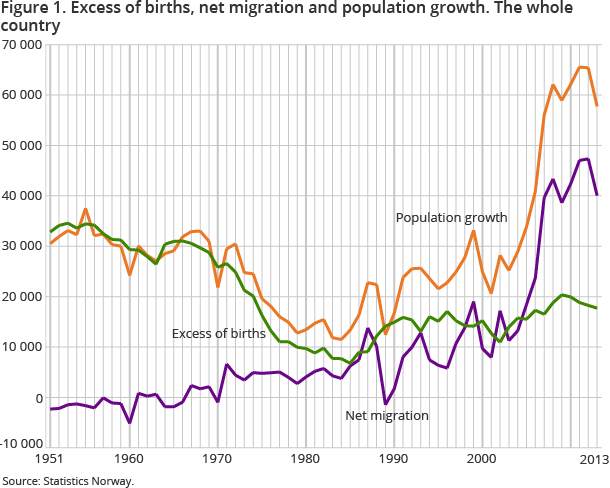
But that's not all. Today we got a report on population trends in 2013 from Statistics Norway and here's the updated "hockey stick":


SSB writes:

The population growth was 1.1 per cent in 2013, which is the smallest percentage growth in Norway since 2006. Net migration from abroad decreased by 7 200 from 2012 to 2013 - down from 47 300 to 40 100, and this is the lowest since 2009.

The implications of lower population growth on housing demand can be significant. There is an impact both directly and indirectly (through lower demand for rental units) on the amount of home buyers in the market. Polish and Lithuanian citizens are the  two largest groups of immigrants. Many of these occupy jobs related to construction and home repairs/maintenance. As the housing starts started to fall only in the end of 2013 (down 17,5 % year-on-year in Q4'13 and a whopping 37 % in Jan'14!), we don't yet see the real effect of a most likely negative job growth in the construction sector in the migration statistics. If the new home sales and housing starts don't improve soon, there will be little doubt about which direction the population growth will go in 2014.

It might be that 2014 will be remembered as the year when the big story of housing deficit (boligmangel) was finally buried?